

 A+ Member


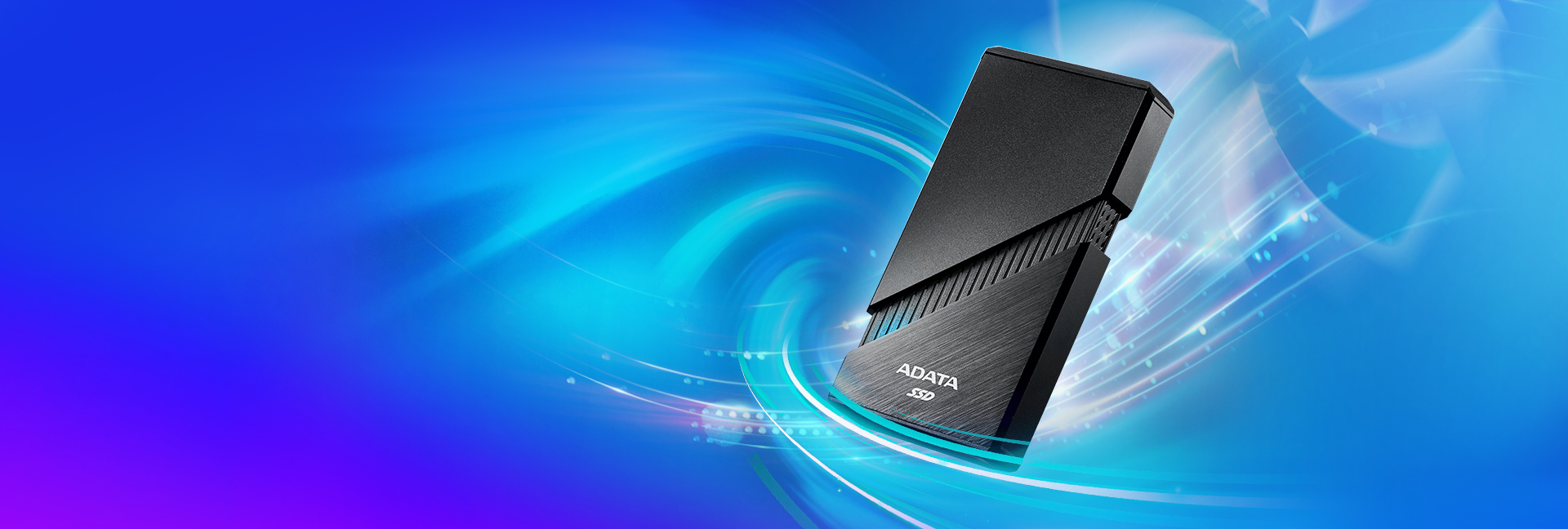
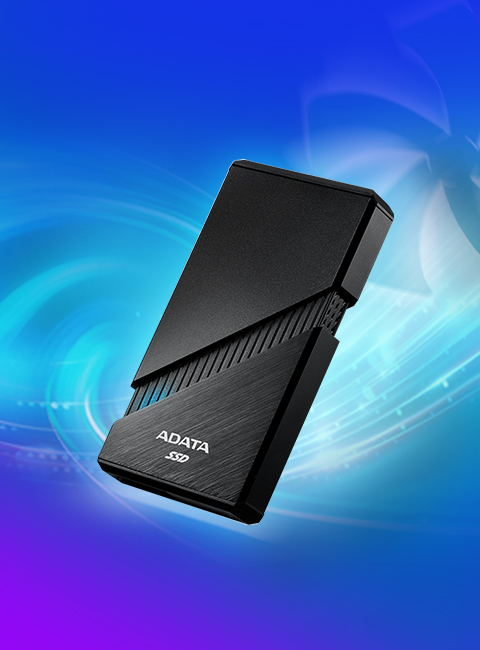



- USB4 40Gbps Type-C interface
- 3,800/3,700MB/s Read/Write performance
- Patented outer shell can be actuated to activate a built-in micro fan, increasing heat dissipation
- Multiple international award winning design - CES Innovation Award 2023, Taiwan Excellence Award 2022, Red Dot Design Award 2022

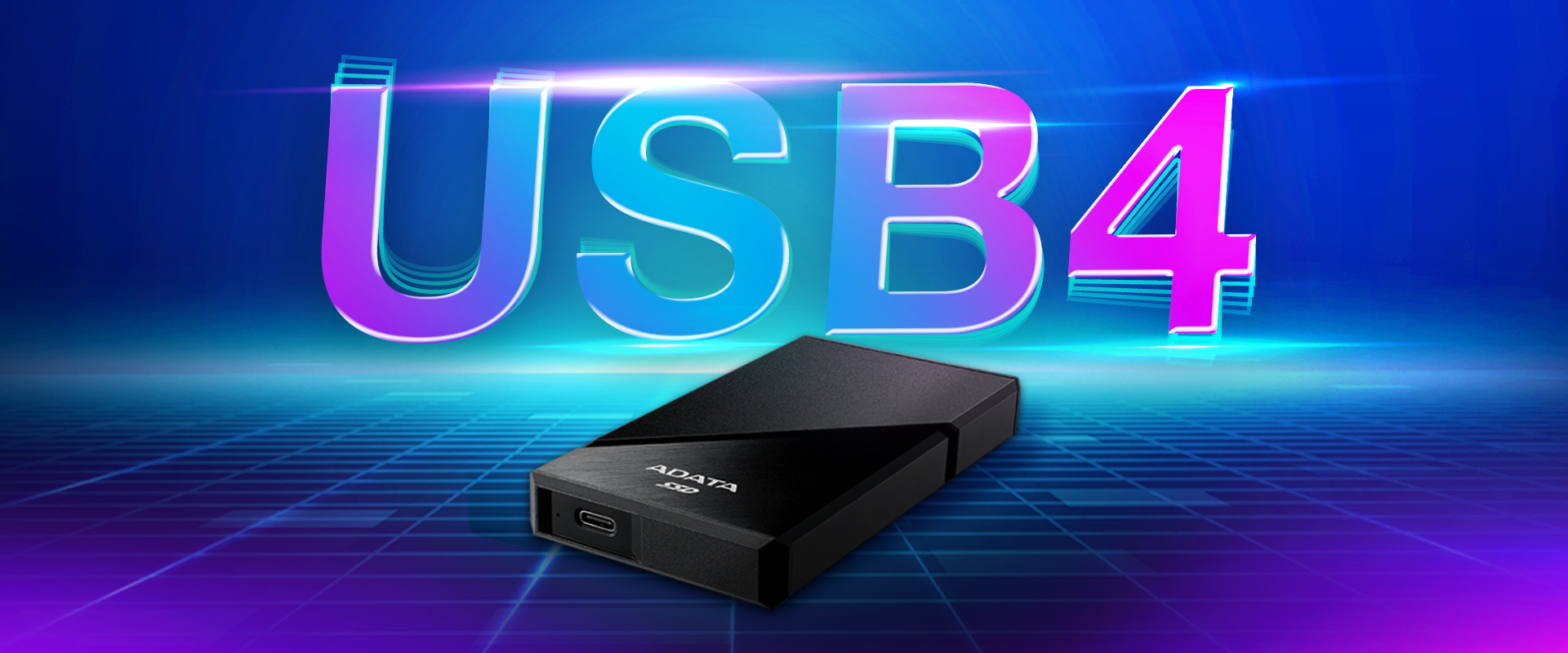
Enter the Era of USB4
The SE920 adopts the latest generation USB4 transmission interface, with speeds reaching up to 40Gbps. It is backward compatible with USB 3.2 and USB 2.0 and supports Thunderbolt3/4. In addition, it features a Type-C port and is able to easily and quickly transfer large audio and video files at ultra-high-speed anytime, anywhere.
*Compatibility test list of systems supporting the USB4 interface can be found here
**Transmission performance may vary depending on the interface specifications of connected device, please refer to the specification for details
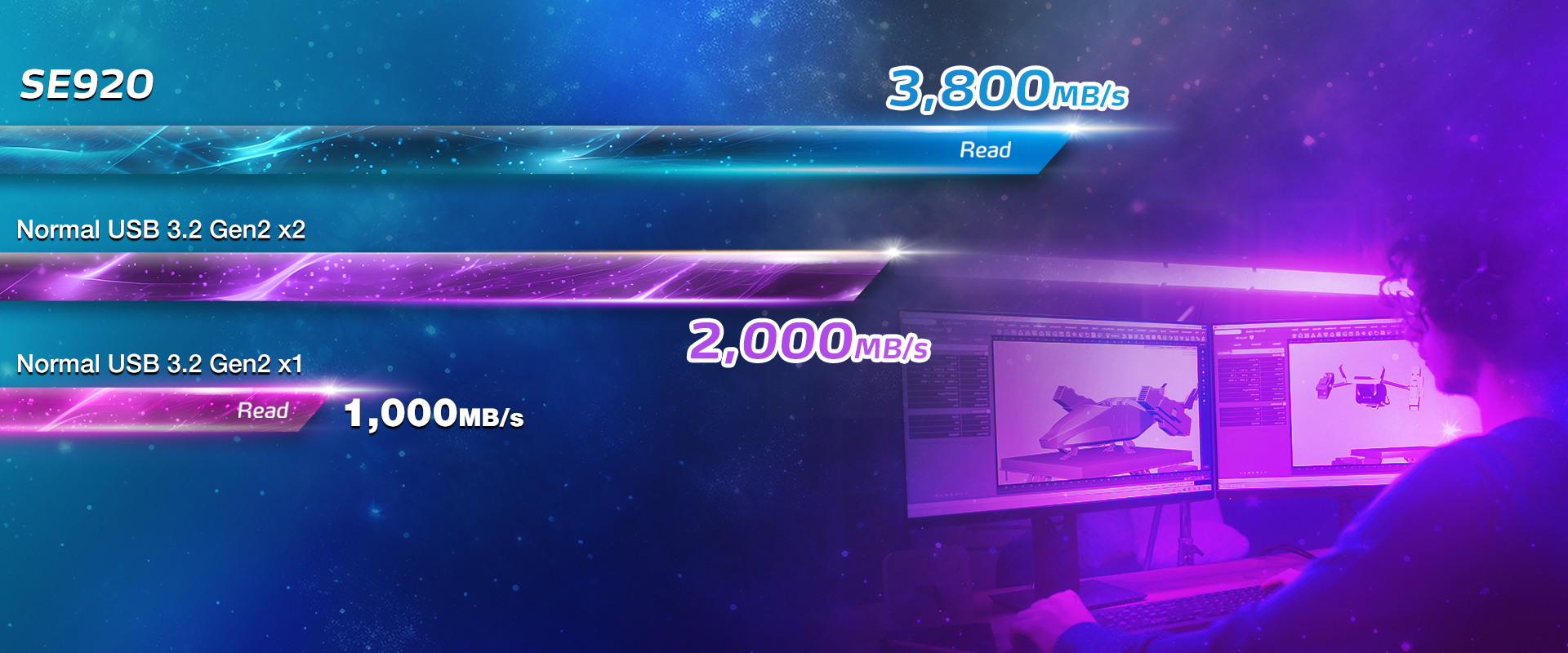
Breakneck Speeds at 3800MB/s
The SE920 features the latest generation USB4 transmission interface, with transmission performance of up to 3,800MB/s. Transfer of a 10GB 4K high-definition video can be completed in about 3 seconds.
*Transmission performance is an estimated theoretical value and actual speed will vary due to system hardware and software configuration.
** When using external storage devices, following the two Windows principles of "Quick Removal" and "Improve Performance" is recommended. Please see link.
Press for Patented Active Cooling
Worried about heat caused by high-speed transfers?!
The SE920 features a unique heat dissipation system with a built-in micro fan. When in use, press down on the case to activate the fan, increasing interior area for cooling and quickly dissipating heat. Press the case again to retract its shroud, making it easy to carry. This ingenious "active patented cooling" system is 10% cooler than fanless products of the same specifications*
*Thermal data is based on internal laboratory testing conditions. Actual figures may vary depending on individual software and hardware and testing environment.
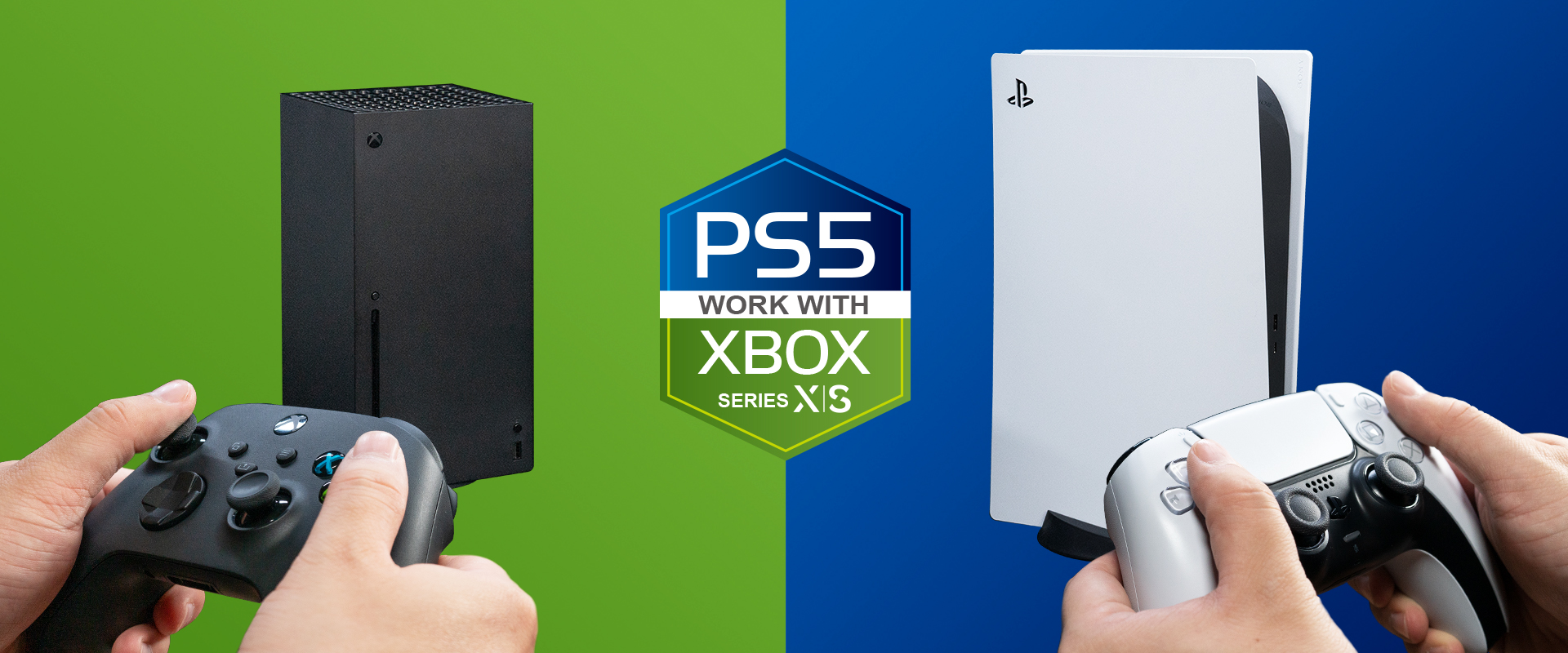
Built for Seamless Gaming
The SE920 can also be connected to a game console to expand your storage. Loading times are faster than traditional hard drives, instantly improving your entertainment and quality of life.
* Actual loading time may vary depending on individual games and disk format may need to be modified before connecting to console.
** Please click here to learn more about external storage device compatibility for each game console.
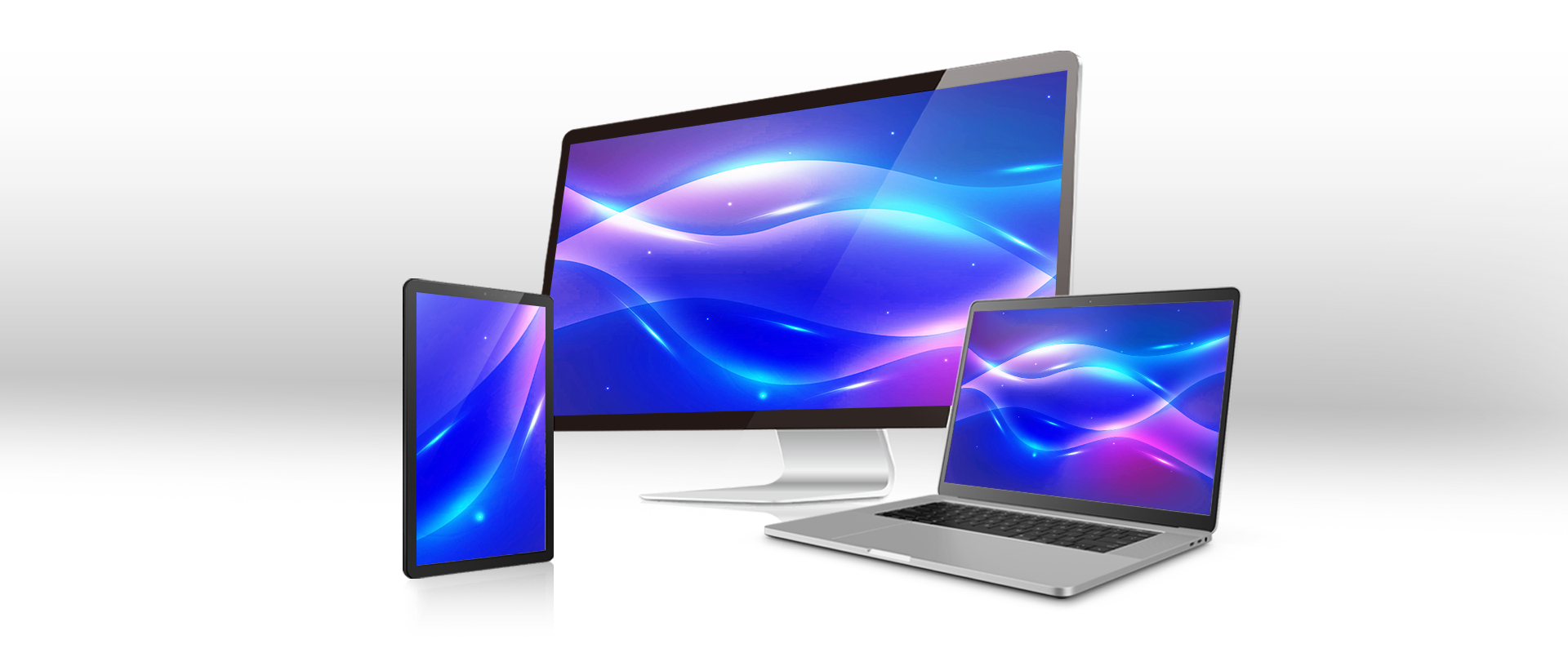
Multi-platform Support Wherever Your Life Takes You
The SE920 utilizes a USB Type-C port, which can connect to different operating systems including Android*, Mac OS, and Windows, computing platforms, and gaming devices. The SE920 can transfer various types of high-definition audio and video anytime, anywhere.
*Mobile device software and hardware must be compatible with and support external SSDs in order to utilize OTG data backup and transfer functionality.
**When connecting a mobile device, ensure the mobile device supplies sufficient power to avoid transfer failure or data loss due to power issues.
***Supported Platforms: Please click here to learn more.
| Color | Black |
|---|---|
| Capacity | 1TB / 2TB / 4TB |
| Weight | 181.52g / 6.4oz |
| Interface | USB4 (USB 40Gbps) ( backward compatible with USB 3.2/2.0 ) |
| Sequential Read (Max*) | Up to 3,800 MB/s |
| Sequential Write (Max) | Up to 3,700 MB/s (USB4) , Up to 3,200 MB/s(Thunderbolt4) |
| Operating system requirements | Windows 10 / 11 MacOS 13 or later (informatting required for use) Linux Kernel 6 or later Android 13 or later |
| Op. Temperature | 5°C(41°F) to 35°C (95°F) |
| Op. Voltage | DC 5V, 3A |
| Accessories | USB4 Type-C to C cable Quick Start Guide |
| Dimensions ( L x W x H ) | Fan-off(Case closed): 105 x 64.2 x 15.9mm / 4.13 x 2.52 x 0.62inch Fan-on(Case extended): 122.56 x 64.2 x 15.9mm / 4.82 x 2.52 x 0.62inch |
| Warranty | 5-year limited warranty |
| Remark |
|
- A: Please click here for more information.
- A: In Windows XP, you can partition disks through Control Panel / administrative tools / computer management / disk management. Select the installed hard disk, and press the right mouse button, and select the option to partition the drive.
- A:
New external SSDs need to be formatted in order for the system to read and write data. The NTFS file system is recommended for Windows system. However, the EXFAT file system is recommended for SE880 external SSD.
- A: There may be compatibility issues with certain security programs for mobile devices that are completely unrelated to the external SSD. Most Android device manufacturers themselves do not guarantee compatibility with such apps. If the OS of your mobile device freezes, reboot the mobile device. If this fails, please contact the device manufacturer.
- A: While most USB devices such as external hard drives, external SSDs, and Flash drives can be plugged and unplugged at will, do avoid doing so when they are active. If you unplug a storage device or a removable drive from your computer while it’s transferring or saving information, you risk data loss or corruption. If in doubt, use the Windows “Safely Remove Hardware” feature, which stops drive operations and then ends the connection between it and the host computer safely.
- A: Make sure the external SSD is securely connected to a USB port. Detection failure may be related to a faulty USB port. If possible, try connecting the external SSD to another USB port. If detection issues persist, please contact ADATA customer service.
- A: 1. Connect the drive to your Windows PC
2. Open the Disk Management tool. You can do that by typing "disk format" or "disk management" in Windows search or going to Control Panel > Administrative Tools > Create and format hard disk partitions
3. Right-click on the external drive partition or the unallocated space you want to format and choose New Simple Volume
4. Follow instructions to choose a volume size
5. Assign a drive letter
6. Choose the file system in the Format Partition screen
7. Give the volume a new name
8. Click Next
9. Click Finish
10. Formatting complete - A: Please click here for more information.
Download here: https://www.adata.com/us/support/downloads/
Read Manuel: https://webapi3.adata.com/storage/support/software_backuptogo/en/backup_togo_manual_en.html
Demonstration Video: https://www.youtube.com/watch?v=CzkjFJzu7nA - A: If data transfer is interrupted, make sure that the error was not caused by a lack of power. If a transmission interruption occurs, please reconnect the device and retry the data transmission. In theory, data will not disappear because of interruptions in the transfer process.
- A: If the external SSD loses power or is unplugged in an unsecure manner, Windows may prevent files from being copied to it. This is a Windows protective measure associated with the file system and does not mean the external SSD has a technical issue. You can try resolving this using the following steps:
- Click the “Scan and Fix” notification that appears when you connect the external SSD to your PC
- If you closed the notification, right-click on the external SSD icon in the system tray (notification area) and use the “Run CHKDSK” command
- If the external SSD icon isn’t displayed in the system tray, open Explorer and select the external SSD, then right-click, Properties, Tools, Check - A: We recommend that you use the Safely Remove Device function before disconnecting the cable between the external SSD and your Android device. Failing to do this may cause copied files to become corrupted and unreadable.
- A: Most new TVs support photo, music, and video playback from external storage via USB. However, not all TVs support this function and file system compatibility may vary. When connecting the external SSD to a TV, please check the following:
- After connecting the external SSD to the TV USB port, check if the external SSD is recognized in the TV menu
- If it isn’t recognized, please refer to the TV user manual or contact the manufacturer to check for USB support
- If it is recognized, check that you can play videos and music and view photos stored on the external SSD without any issues
- In case content can’t be accessed, verify which file systems are supported by your TV for external storage. The external SSD is formatted using the NTFS file system by default
- Follow any prompts from your TV operating system relating to the external SSD formatting. Modern TVs will auto-format external storage to a supported file system
■Important: formatting will delete all data. Please backup your data before proceeding If the file system is supported but you still can’t access content, verify the file types and extensions supported by the TV. - A: The actual drive capacity displayed on your device will vary from external SSD physical capacity due to mandatory operating system formatting and partitioning. Typically, operating systems remove 10-20% of drive physical capacity. This means a 250GB external SSD will have around 232GB free once it is fully formatted and detected by a supported operating system
- A: Differences in size shown are mainly due to differences in computer operating systems, the calculation method for an external hard drive capacity, and the Controller IC’s operations result in different ways. Generally, hard disk manufacturers usually calculate capacity based on the decimal system, and computer systems are actually binary. Hard drive manufacturer: 1KB = 1000 Bytes, 1MB = 1000KB, 1GB = 1000MB, 1TB = 1000GB
Operating system: 1KB = 1024 Bytes, 1MB = 1024KB, 1GB = 1024MB, 1TB = 1024GB
So for example, a hard disk marked as 500GB capacity is 500GB = 500 x 1,000MB x 1,000KB x 1,000Bytes = 500,000,000,000 Bytes, but in binary the capacity is calculated as 500,000,000,000 Bytes / 1024KB / 1024MB / 1024GB, approximately 465GB.
Fastest method of calculation: the hard disk capacity x 0.93 = the approximate actual hard disk capacity - A: UASP stands for USB Attached SCSI Protocol. It combines SCSI commands and USB standards to accelerate data movement and make file transfers more efficient. If your device does not support UASP, you may update it from the device manufacturer website, as UASP functionality can be added via firmware or operating system update.
- A: Solid State Drives (SSD) are storage devices like hard drives, but with much better performance, especially as regards random access speeds. But because of their higher price, they are often more suitable to be used as the drive from which the operating system is run. The slower speeds of HDDs mean they are likely to be used as data backup media, and for data archives.
- A:
Backup ToGo does not support an encryption function. Use of built-in Windows encryption software BitLocker is recommended (click here to enable BitLocker encryption mechanism on Windows 10 devices).