


 Member Center


 Contact Sales

Edge AI for Smart Hubs and Appliances
Smart hubs, smart TVs, and smart home appliances continue to integrate operating systems, multimedia applications, and Edge AI capabilities, driving ever-increasing storage capacity requirements for system images, applications, and data. Meanwhile, these products must maintain stable boot speeds and read/write performance under long-term operation and frequent data access, while also ensuring reliability and long-term supply availability.
ADATA eMMC 5.1 embedded storage supports HS400 mode and capacities up to 256GB, delivering industrial-grade reliability, long-term supply support, and stable performance throughout smart home device life cycles.
Industrial-Grade Storage Stability for Smart Hubs
ADATA eMMC 5.1 in HS400 mode with 64GB / 128GB / 256GB capacities, delivering reliable performance for OS, applications, and data storage in smart home devices.

Always-On Home Security and Surveillance
Smart security cameras and video doorbells record around the clock, generating intensive continuous and random writes that quickly wear out consumer-grade storage. Outdoor installations also face temperature swings that threaten data integrity and device stability.
ADATA industrial-grade eMMC with pSLC solution delivers the endurance required for 24/7 recording, keeping outdoor devices reliable in harsh environments.
Ultra-Endurance Storage for Continuous Surveillance
High-endurance embedded storage with pSLC eMMC 5.1 option, engineered for continuous-write workloads.
eMMC 5.1
- JEDEC Standard: eMMC 5.1 Interface
- DDR HS400 Mode
- Capacity: 64GB
- Operating temperature:-25°C~85°C
- Package size: 11.5x13x0.8mm / 11.5x13x1.0mm
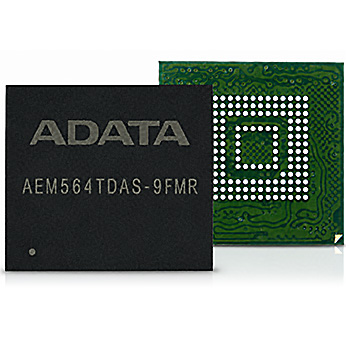
eMMC 5.1 pSLC Solution
- AEM516PDAS-9FMR provides stable storage for always-on smart devices
- HS400 mode, 16GB high-endurance pSLC storage
- Standard (-25°C~85°C) version, 11.5x13x1.0mm package, built for 24/7 continuous-write devices
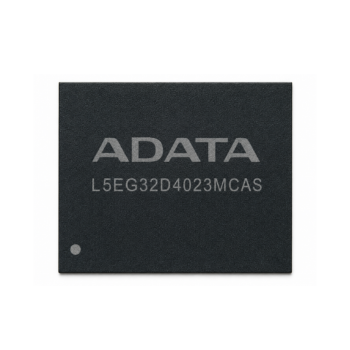
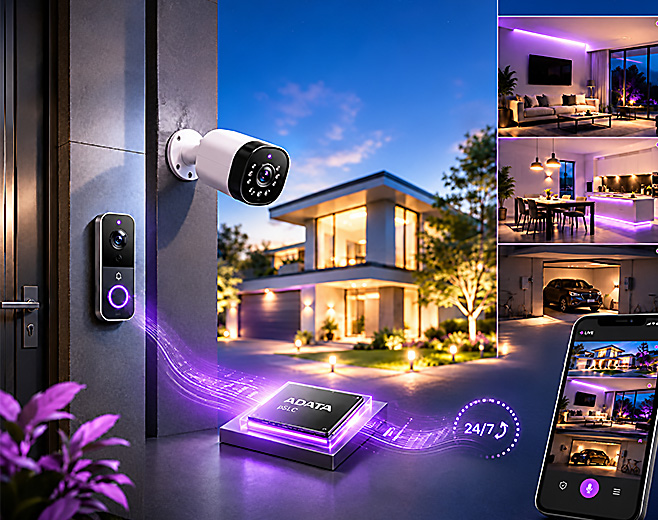
pSLC High-Endurance Technology
pSLC (pseudo-SLC) technology operates TLC NAND in single-bit mode, dramatically increasing write endurance and reliability. For always-on smart home devices such as security cameras that write data continuously, pSLC solutions extend product lifespan and maintain stable write performance, while providing a balanced choice between endurance and cost.
Low-Power Design for Extended Battery Life
ADATA embedded solutions are engineered for battery-powered devices: LPDDR5X delivers up to 8533 MT/s bandwidth with low-power operation, while compact, thin packages such as 0.8mm-profile eMMC reduce both footprint and thermal load. Combined with industrial-grade reliability and long-term supply stability, these solutions help portable and wearable products run longer between charges across long product life cycles.
eMMC is the industry-standard choice whenever storage needs to be soldered down, space-constrained, and cost-effective. Common deployments include smart home appliances, industrial PCs (IPCs), networking hardware, POS terminals, medical devices, and surveillance systems. Designed in a compact FBGA 153-ball package (only 11.5 × 13 × 1.0 mm), it effortlessly fits into ultra-slim hardware architectures where an M.2 or 2.5-inch drive cannot be accommodated.
Beyond consumer devices and industrial automation, eMMC is widely deployed as a reliable boot and firmware drive in IoT gateways, digital signage, interactive kiosks, handheld scanners, test and measurement instruments, and edge AI modules. It serves as an ideal self-managed boot device for any application demanding high operational stability across wide temperature ranges.
To maximize eMMC endurance, host system architectures should minimize unnecessary write operations (e.g., buffering system logs in RAM before flushing to storage), maintain sufficient unallocated space to support Garbage Collection (GC), enable TRIM command support in the OS, align disk partitions to erase block sizes, and prevent prolonged operation under extreme temperatures. While integrated LDPC ECC and Bad Block Management provide internal wear mitigation, write-aware host firmware design remains the single most effective factor in prolonging device lifespan.
The series operates with a VCC supply voltage of 3.3V and a selectable VCCQ (I/O voltage) of 1.8V or 3.3V, ensuring seamless compatibility with both legacy platforms and low-voltage host designs. It supports an operating temperature range of -25°C to 85°C and a storage (non-operating) range of -40°C to 85°C, making it fully qualified for 24/7 continuous operation, networking infrastructure, and outdoor-adjacent industrial deployments.