

 Member Center


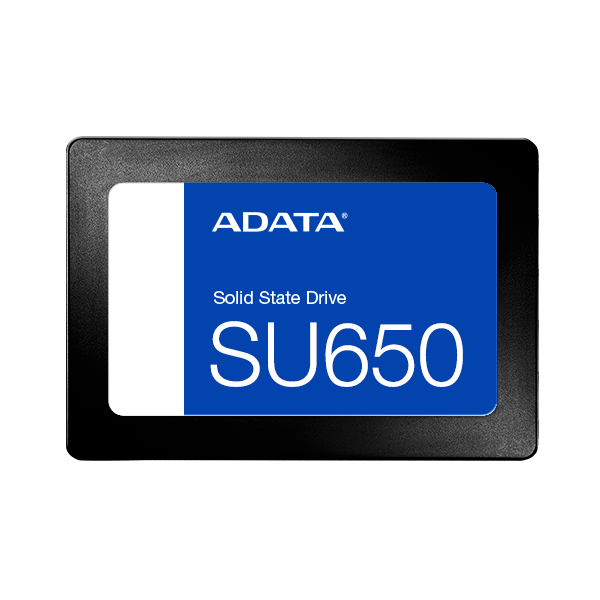
إذا كنت ترغب فى استبدال وحدة التخزين HDD لديك بوحدة تخزين أخرى SSD ، فسوف تكون ADATA SU630 هى اختيارك الأمثل. لقد تم تزويد وحدة التخزين بالجيل القادم من الذاكرة QLC 3D NAND Flash لتقدم لك أداء فائق و جودة عالية، هذا بجانب العديد من التقنيات و الخصائص المتميزة مثل تقنية تصحيح الأخطاء LDPC ECC .
للبحث عن توافقية وحدة التخزين SSD : اضغط هنا
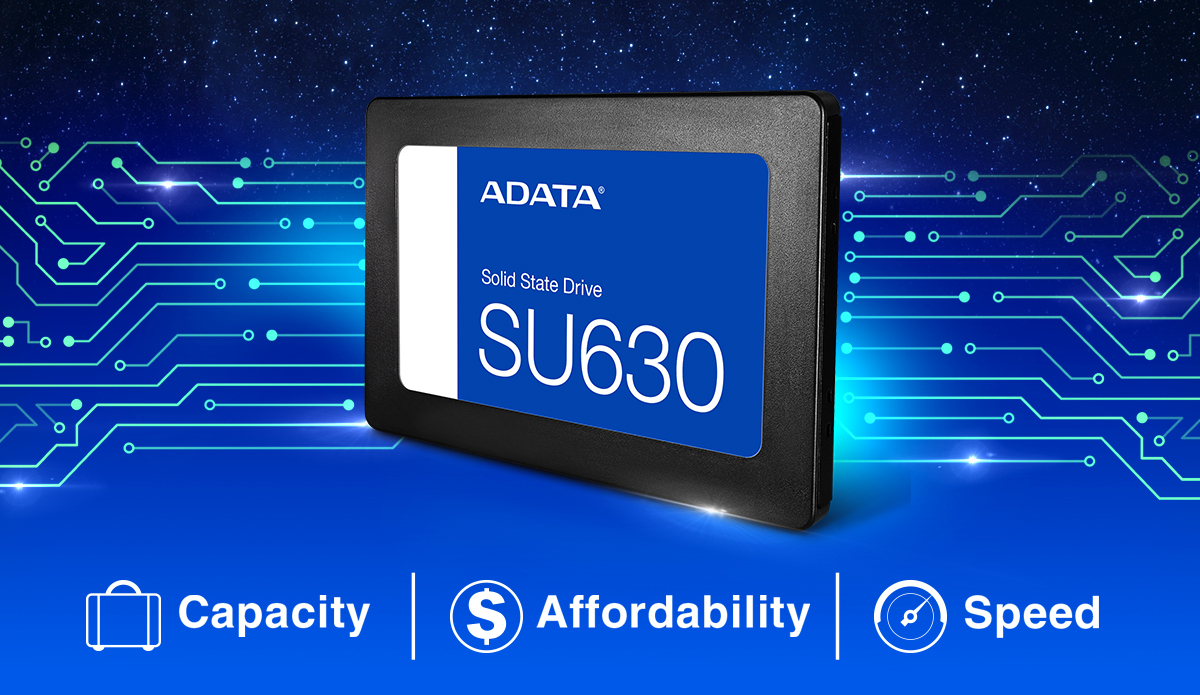
3D QLC SSD ــ سعة تخزينية كبيرة بسعر فى متناول يدك
من خلال الذاكرة QLC 3D NAND Flash و سعة تخزينية 1.92TB و سعر مناسب جداً، تأتى وحدة التخزين SU630 لتكون هى الاختيار المثالى للتحديث و التبديل من وحدات التخزين HDD إلى SSD ، و ذلك سواء كنت ترغب فى استخدامها لبدء تشغيل نظام حاسبك أو لتخزين ملفاتك الضخمة.
أداء أكثر قوة مع الذاكرة الذكية SLC Caching
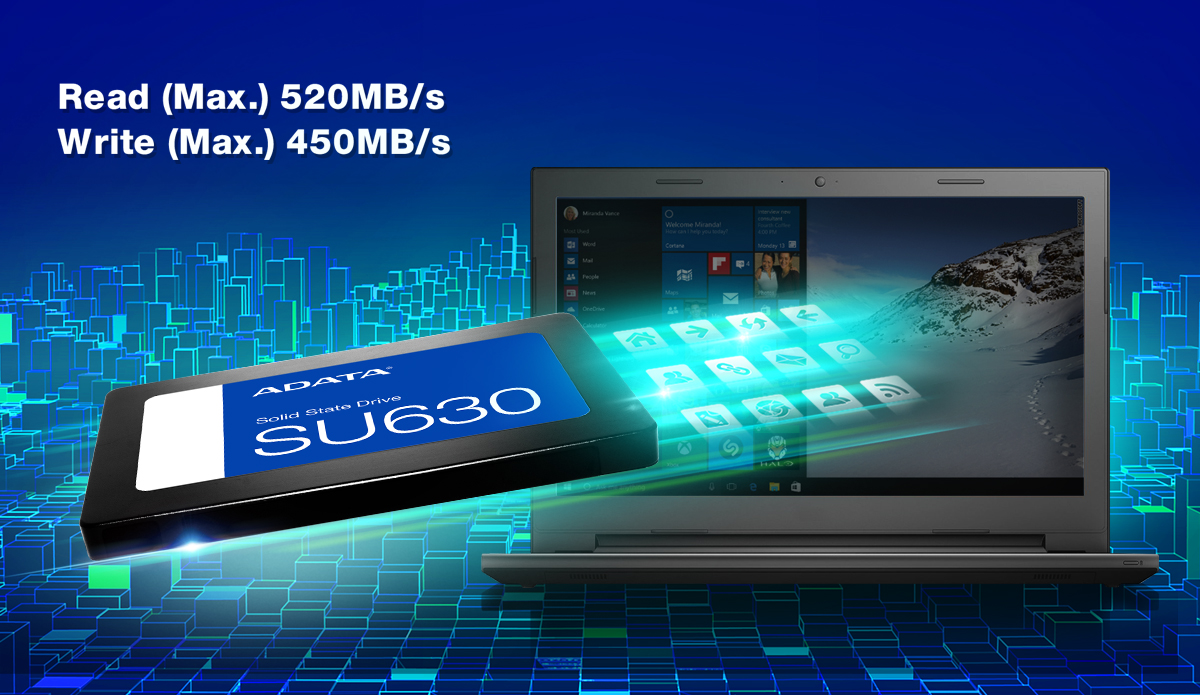
تتيح التقنية الذكية SLC caching للذاكرة NAND Flash العمل على مستوى كل خلية على حدة و ذلك لتقوية الأداء و رفع سرعة عمليات القراءة/الكتابة لتصل إلى 520 / 450 ميجابايت/ث ، و هو الأمر الذى ستستمتع معه بسرعة بدء تشغيل حاسبك و سرعة نقل ملفاتك و سرعة تحميل محتويات الإنترنت.
مزيد من دقة و تكامل البيانات
من خلال تقنية تصحيح الأخطاء LDPC (Low-Density Parity-Check) ، تستطيع وحدة التخزين SU630 رصد و تصحيح أخطاء البيانات، و ذلك لضمان دقة و تكامل البيانات و مزيد من العمر الافتراضى لوحدة التخزين.
أكثر قوة، أكثر هدوءاً، و أعلى جودة
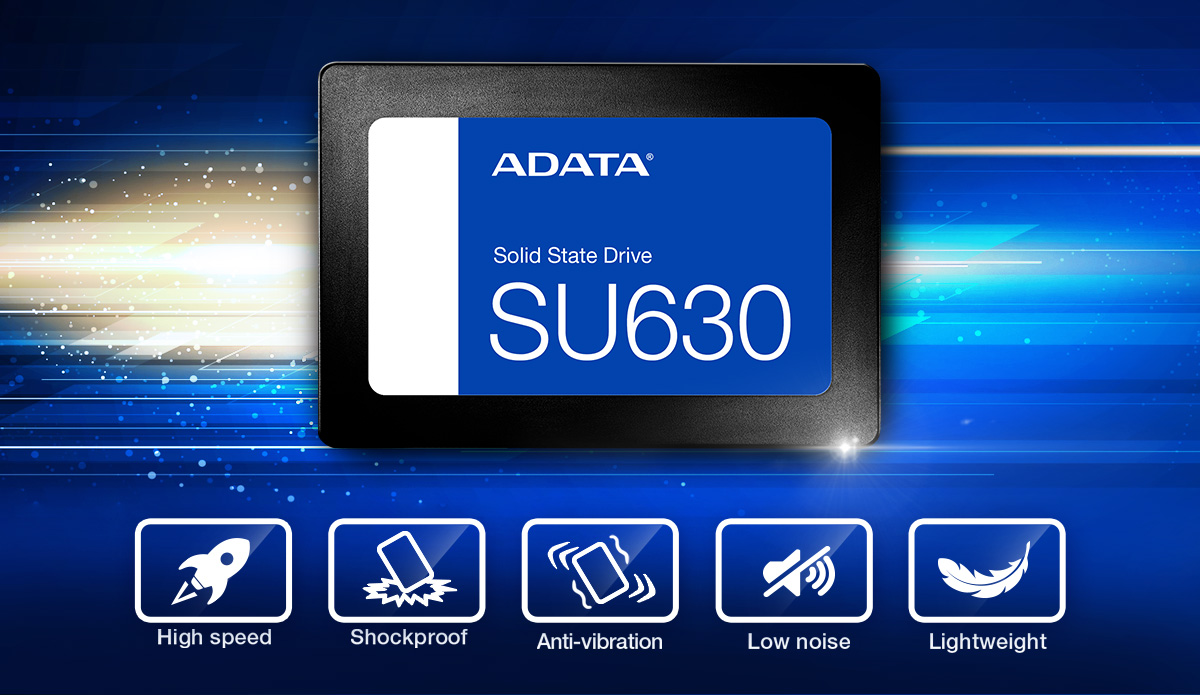
لا تحتوى وحدات التخزين SSD على أى مكونات ميكانيكية، و بذلك تتفوق على وحدات التخزين HDD التقليدية بقدرة أكبر على احتمال الصدمات، و مقاومة الاهتزاز (1500G/0.5ms) ، و احتمال درجات الحرارة المرتفعة ( 0° ــ 70° مئوية) ، و بذلك تتمكن من توفير حماية أفضل لبياناتك. كما تتميز أيضاً وحدات التخزين SSD بالهدوء التام و عدم إصدارها لأى ضجيج، فضلاً عن استهلاكها البسيط للطاقة.
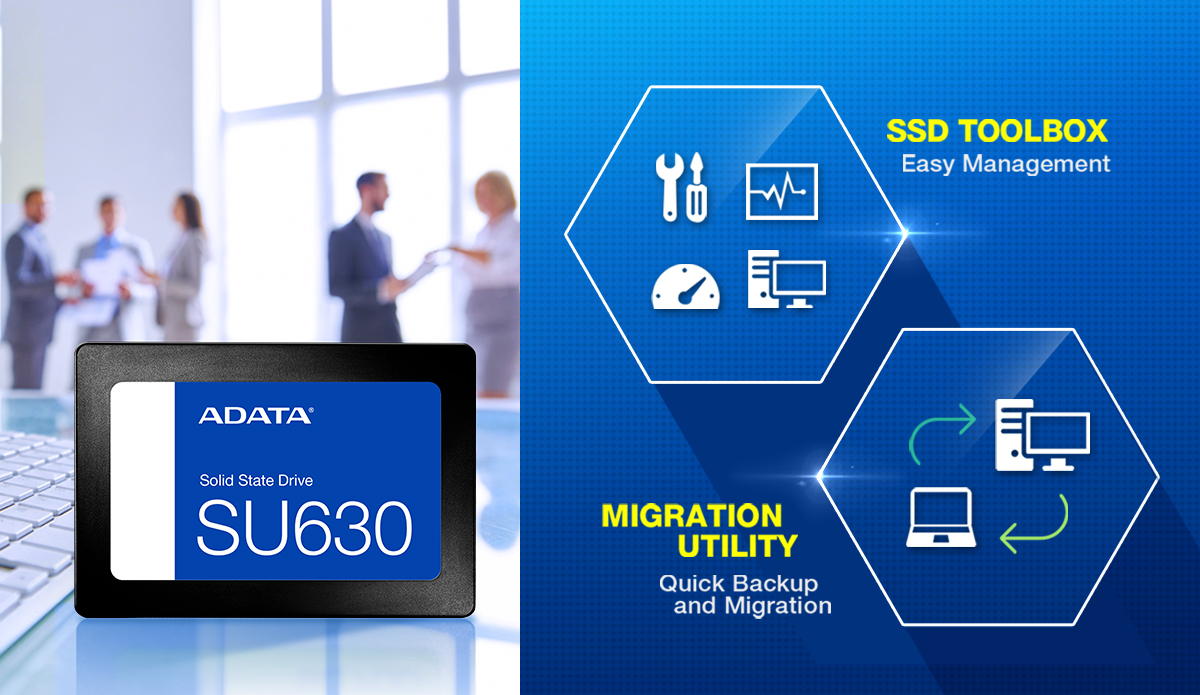
برامج من أجل راحتك - SSD Toolbox و Migration Utility
إن شراءك لوحدة تخزين SU630 يؤهلك لتحميل برنامج SSD Toolbox و أداة Migration Utility مجاناً من ADATA . هذا و يتيح لك برنامج SSD Toolbox متابعة كل ما يتعلق بوحدة التخزين SU630 و ذلك مثل حالة وحدة التخزين و معدل استخدام خلايا الذاكرة و معلومات العمر الافتراضى لها. أما أداة Migration Utility فتساعدك على الانتقال من وحدة تخزين HDD إلى وحدة SSD ، حيث تم تصميم هذه الأداة لتوفير السرعة و السهولة عند إنشاء النسخ الاحتياطية و ترحيل محتويات وحدة التخزين بالكامل بما يشمل نظام التشغيل.
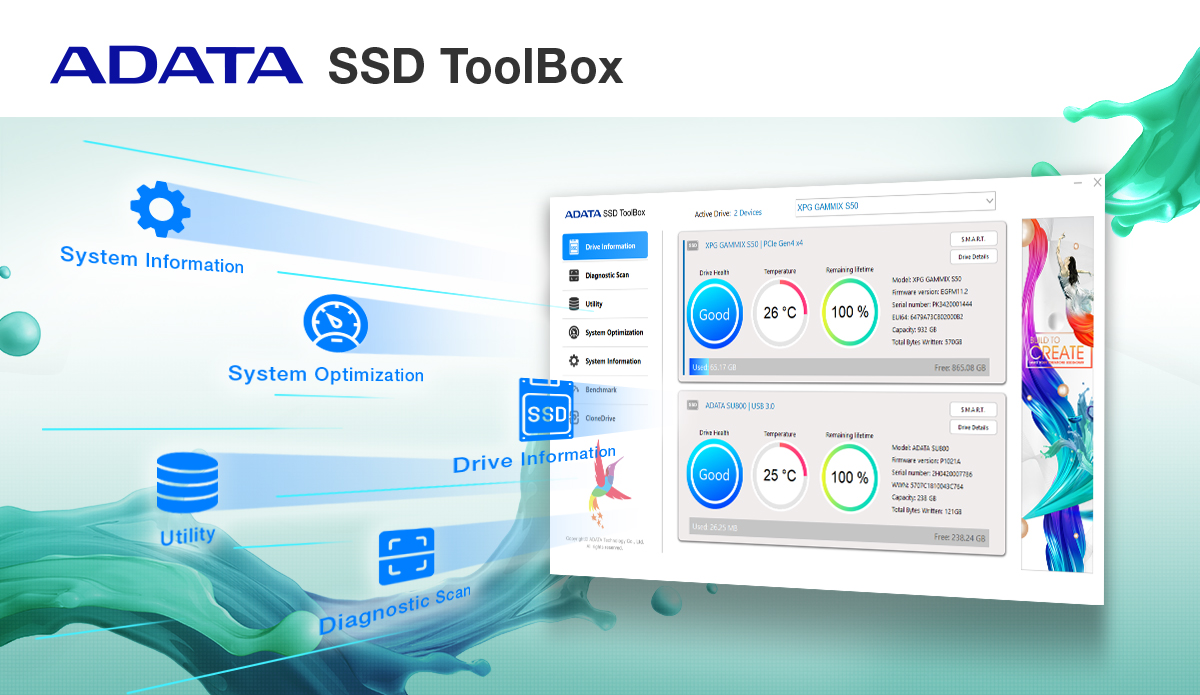
صندوق أدوات SSD: القائم بحل مشاكل SSD
يساعد صندوق أدوات SSD على تحسين الأداء والاستقرار الشامل من خلال أحدث تحديثات البرنامج الثابت، مع حل المشاكل العرضية الثانوية المتعلقة بالجهاز والبرامج أيضًا. تراقب لوحة معلومات الحالة وتحلل وتعطي تقارير حول بيانات S.M.A.R.T.، مما يسمح للمستخدمين التحقق من صحة SSD والحفاظ على عمره الافتراضي، علاوة على درجة حرارة التشغيل الحالية والسعة التخزينية-بحيث يمكنك البقاء مسيطرًا على حالة SSD في كل الأوقات.
*لحماية SSD والبيانات القيمة؛ إبق البرنامج الثابت لديك محدثًا. انقر هنا لتحميل صندوق أدوات SSD لمزيد من التفاصيل.
| القدرة | 240GB / 480GB / 960GB / 1.92TB |
|---|---|
| حجم المنتج | 2.5" |
| ذاكرة NAND Flash | 3D NAND |
| الأبعاد (الطول × العرض × الارتفاع) | 100.45 x 69.85 x 7mm / 3.95 x 2.75 x 0.27inch |
| الوزن | 50.8g / 1.79oz |
| واجهة التوصيل | SATA 6Gb/s |
| القراءة المتسلسلة (الحد الأقصى*) | حتى 520MB/s |
| الكتابة المتتابعة (حد أقصى) | حتى 450MB/s |
| درجة حرارة التشغيل | حتى 0° ــ 70° مئوية |
| درجة حرارة التخزين | ـ40° ــ 85° مئوية |
| مقاومة الصدمات | 1500G / 0.5ms |
| MTBF | 1.500.000 ساعة |
| عدد التيرابايت المكتوبة (سعة قصوى*) | 400 تيرابايت |
| الضمان | اعتباراً من 2019/7/1 تم مد فترة الضمان المحدود لوحدة التخزين SU630 حتى ثلاث سنوات. المنتجات التى تم شراؤها قبل أو حتى 2019/6/30 تحتفظ بفترة الضمان المحدود الأصلية سنتان (مرفق). |
| ملحوظة |
|
- A:ج: أولاً، يرجى الرجوع إلى دليل مستخدم النظام خاصتك للتأكد من أن المشكلة لا تتعلق بالجهاز المضيف أو الجهاز. وننصحك بالقيام ببعض إصلاحات الأعطال الأساسية على مستوى البرنامج. استخدم صندوق أدوات SSD للتحقق من حالة SSD خاصتك، ثم توجه إلى "Utility" في الشريط الجانبي الأيسر وحدد "Firmware Update" للتحديث. ما أن يكتمل التحديث، أعد تشغيل نظامك - وهذا يمكن أن يساعد على حل المشاكل العرضية مثل هذه.قبل تحديث البرنامج الثابت، تأكد من نسخ بياناتك القيمة نسخًا احتياطيًا وإبقاء النظام متصلاً بالكهرباء طوال عملية التحديث لتفادي فشل التحديث.
- A:
يرجى أولاً التأكد مما إذا كنت ضبطت SSD كقرص افتراضي (Control Panel>System and Security>Storage Spaces). يتعذر على Toolbox اكتشاف قرص افتراضي. يمكنك حذف القرص الافتراضي على Storage Spaces "مساحات التخزين" أو تنسيق SSD وبدء تشغيله في Disk Management "إدارة القرص". سوف يتعرف Toolbox على SSD بعد ذلك.
- A:
ADATA SSD warranties are based on warranty period or Total Terabytes Written (TBW).
1. Please refer to this link for specific warranty information for your product.
https://www.adata.com/sa/support/warranty/
2. Please refer to this link for the TBW of your product.
- A:
DRAM buffer is a function designed to improve the efficiency of reading and writing. Generally, it is composed of 1 to 2 DRAM modules on an SSD. Whether an SSD has a DRAM buffer is often decided by the manufacturer according to its market positioning. Generally speaking, entry-level models do not typically have a DRAM buffer.
- A:
Wear leveling is a process that is designed to extend the life of solid state storage devices. SSDs are store data in blocks. Each block can tolerate a finite number of program/erase cycles before becoming unreliable. For example, MLC NAND flash is typically rated at about 3,000 program/erase cycles. Wear leveling arranges data so that write/erase cycles are distributed evenly among all of the blocks in the device.
- A:
SSD TRIM is an Advanced Technology Attachment (ATA) command that enables an operating system to inform a NAND flash solid-state drive (SSD) which data blocks it can erase because they are no longer in use. The use of TRIM can improve the performance of writing data to SSDs and contribute to longer SSD life. Currently, TRIM is used in Windows 7, Server 2008, Mac OS 10.7, and newer versions of Linux. In addition, regardless of operating system, no RAID configuration supports TRIM.
- A:
According to the Serial ATA International Organization the SATA 3.0 specification offers transfer speeds up to 6Gbps compared to 3Gbps for SATA 2.0. Regardless, SATA 2.0 and SATA 3.0 use the same interface and cables.
- A:
At present, various storage methods, including optical discs, hard drives, and SSDs are not ideal for storing data permanently. Therefore, we recommend that important data be backed up to several different devices to diversify your risks.
- A:
The lifespan of an SSD is based on its health. ADATA's SSD ToolBox is a set of auxiliary software for checking SSD health. In principle, your health will be determined by the length of time you use your SSD and the number of read and write cycles. The longer you use it, the more read and write cycles, the shorter the lifespan of your SSD. Generally speaking, SSDs have wear-leveling technology built-in that helps extend the lifespan of your SSD. However how you use your SSD is the main factors in determining your SSDs lifespan. If a large amount of data is written over a long period of time or if you use your SSD in extreme environments, lifespan may be shortened.
Download ADATA SSD ToolBox: https://www.adata.com/ma/support/downloads/
- A:
Speeds may vary because different test software use different parameter settings and test methods, and the different testing environments and PC configurations may also have an influence (for example: different motherboards or CPUs, etc.). In addition, the amount of free space, namely lack of, will also affect writing speeds. For better performance, you can try the following:
1. Please check if the slot currently used by the SSD can support the specifications of the SSD. (For example, if a PCIe Gen3x4 SSD is inserted into a PCIe Gen3x2 slot, the speed will be limited by the PCIe Gen3x2 slot)
2. Remove unnecessary software or data from the SSD, or reformat it.
3. Use CrystalDiskMark or ATTO Disk Benchmark to test your SSDs speeds.
4. If your SSDs speed is still slow, please take a screenshot of your SSDs speed test results and send it to our customer service staff for review.
- A:
The difference in capacity is mainly due to the different calculation methods used by your PCs operating system and the SSD. SSDs calculate capacity based on the decimal system, e.g.: 1KB - 1000 Byte bytes, 1MB - 1000KB, 1GB - 1000MB, 1TB - 1000GB, and so on; Your PCs operating system uses the binary system, e.g. 1KB x 1024 Byte byte, 1MB x 1024KB, 1GB x 1024MB, 1TB x 1024GB, and so on. For example, if the packaging shows capacity or 500GB, it is calculated as follows: 500GB x 500 x 1,000MB x 1,000KB x 1,000Byte x 500,000,000,000Byte. Your PCs operating system will calculate as follows: 500,000,000,000 Byte/1024KB/1024MB/1024GB, or approximately 465GB.
Remarks: For a faster calculation method, the capacity listed on the packaging can be calculated as x0.93=SSD for approximate capacity
- A:
HDD Sentinel Health displays anomalies because this tool incorporates the S.M.A.R.T attribute 168 (A8), 159 (9F) fields into the health display, but these two fields are self-defined by each vendor, so these two fields are not associated with health calculations. Please remove the wrong interpretation position of the two fields according to the illustration, and the SSD health can be displayed as normal.
- A:
This is related to the storage format of your SSD. If using the Windows FAT32 format, the maximum size of any single file is limited to 4GB. To avoid this situation, please change reformat your SSD to NTFS.
- A:
Troubleshoot with the following:
1. The SSD has wear-leveling technology built-in to enhance the product's lifespan. The slower speeds may be due to concurrent reformatting, but this situation is not common, especially when it is not a brand new SSD. Contact our customer service staff for help in troubleshooting.
2. Insufficient free space will also affect the writing speed. You can try to delete files to free up space on your SSD.
- A:
ADATA SSDs are designed in accordance with the Serial ATA International Organization standards and have undergone rigorous testing to ensure they work with various operating systems.
Note:
1. NVMe (PCIe) M.2 SSDs require Windows 8.1 or later to support the NVMe driver (we recommend Windows 10 for better the best experience and usability). Linux, including Fedora, SUSE, Ubuntu, and Red Hat, is also supported.
2. AHCI(SATA) M.2 SSDs can be used with Windows 7 or later.
- A:
Since SSDs don't have mechanical drives, so there is no need for defragmentation. Defragmenting an SSD may cause unnecessary wear and tear. SSDs are designed to write data evenly on the entire drive as much as possible, thereby reducing excessive wear on any one location.
- A:
ADATA SSDs can use standard drivers, which can be applied to different operating systems; at the same time, users can also install the drivers officially provided by the motherboard manufacturers. If you have other questions, please contact ADATA's customer service center.
Note:
1. NVMe (PCIe) M.2 SSDs require Windows 8.1 or later to support the NVMe driver (it is recommended to update to Windows 10 or later). Linux series such as Fedora, SUSE, Ubuntu, Red Hat are also supported
2. AHCI (SATA) M.2 SSDs are compatible with Windows 7 and later
- A:
Set up RAID 0 on a compatible motherboard, then connect two SSDs of the same specification to the set port. For detailed instructions, please refer to your motherboard's user manual. The performance of the SSD with a RAID 0 configuration will be double that of a single SSD.
- A:
If you have used the SSD normally before, but then fails to format, please try the following steps:
1. Enter "diskpart" in the command line of the "Start" menu and press "Enter" (or use the "Windows" key and "R")
2. Enter "List disk" and press "Enter" to check the hard disk number (the system disk is Disk 0. If only 1 SSD is connected, it should labeled as Disk 1.)
3. Type "select disk 1" and press "Enter" to select the SSD
4. Type "clean" and press "Enter", the partitions of the SSD will be deleted
- A:
1. Make sure you have already formatted and partitioned your new 2.5" SATA of M.2 SSD. For detailed instructions for Windows 7, please click here; For Windows 8.1 or Windows 10, please click here; For Windows XP, please click here.
2. If your SSD cannot be detected (including unrecognizable, unreadable, etc.) after it has worked normally for a period of time, please follow steps:
M.2 SSD => Loosen the screws and remove the M.2 SSD and check the interface connector for dirt or scratches. Then reinstall it.
SATA 2.5-inch SSD => Unplugged the SATA cable and check the interface connector for dirt or scratches. Then reinstall and ensure the cable is properly plugged in. In some cases, an old cable may cause your SSD to not be detected.
If you have tried the above but the problem persists, the SSD might be faulty. Check your warranty period on ADATA's official website.
Query URL: https://www.adata.com/sa/support/warranty/
- A:
إذا واجهت هذه المشكلة فيرجى الرجوع إلى دليل مستخدم اللوحة الأم أو موقع الشركة المصنعة على الويب. تختلف اللوحات الأم حسب الموديل والعلامة التجارية. نوع وعدد منافذ الدخل/الخرج ليست هي نفسها، لذلك، عند إدخال محرك أقراص SATA أو NVMe M.2 SSD في الفتحة، فقد يتأثر بالدخل/الخرج. ينتج عن مشاركة القنوات بواسطة المنافذ عدد محدود من القنوات التي تدعمها مجموعة الشرائح، مما يجعل بعض مآخذ SATA ذات 7 دبابيس غير قابلة للاستخدام.
- A:
لا يزال بإمكان أجهزة الكمبيوتر التي لا تدعم محركات أقراص SSD من PCIe Gen4 استخدام محركات أقراص SSD المذكورة. ومع ذلك يقتصر أداء محركات أقراص SSD على مستويات PCIe Gen3.
- A:
أولاً، تحقق من صنع ومواصفات اللوحة الأم على موقع الشركة المصنعة لمعرفة ما إذا كانت تحتوي على فتحات M.2 تدعم PCIe 4x4. إن وجدت فتحتان M.2 PCIe 4x4 فيمكن استخدام الرابط المباشر إلى مقبس M.2 الخاص بطرفية وحدة المعالجة المركزية (المعالج المركزي) للحصول على أداء أفضل.
- A:
أولاً، تأكد من عامل شكل أقراص SSD - M.2 أو mSATA أو SATA. حدد نوع الفتحة الصحيح على اللوحة الأم، وأدخل SSD، وتثبته بالمسامير. للحصول على فيديو بإرشادات M.2 SSD على سطح المكتب يرجى النقر هنا، وM.2 SSD على الكمبيوتر المحمول يرجى النقر هنا، وSATA SSD على سطح المكتب يرجى النقر هنا، وSATA SSD على الكمبيوتر المحمول يرجى النقر هنا.
- A:
إذا كان لديك قرص M.2. بالنسبة لمحرك أقراص 2280 SSD يمكن العثور على تعليمات التركيب هنا.