

 A+ Member




- PCIe Gen5 x4 transmission interface
- Up to 10,000/10,000MB/s sequential read/write speed
- Dual-layer aluminum alloy and fan forms a patented active air cooling system
- Compared with a fanless heat sink, temperatures significantly reduced by 10%
- Surface crystallization improves thermal conductivity
- Operates long-term without slowing down or crashing
- 2000GB capacity
- Supports latest Intel and AMD platforms
- 5-year warranty
*Download SSD Toolbox for the latest Firmware to optimize performance and obtain other value-added functions
** Check the link for the compatibility testing list of motherboards supporting PCIe Gen5 SSD. This product is compatible with Gen4 and Gen3 platforms, but the performance may be limited. Optimal Gen5 performance requires a Gen5-compatible platform.

Extraordinary Speed
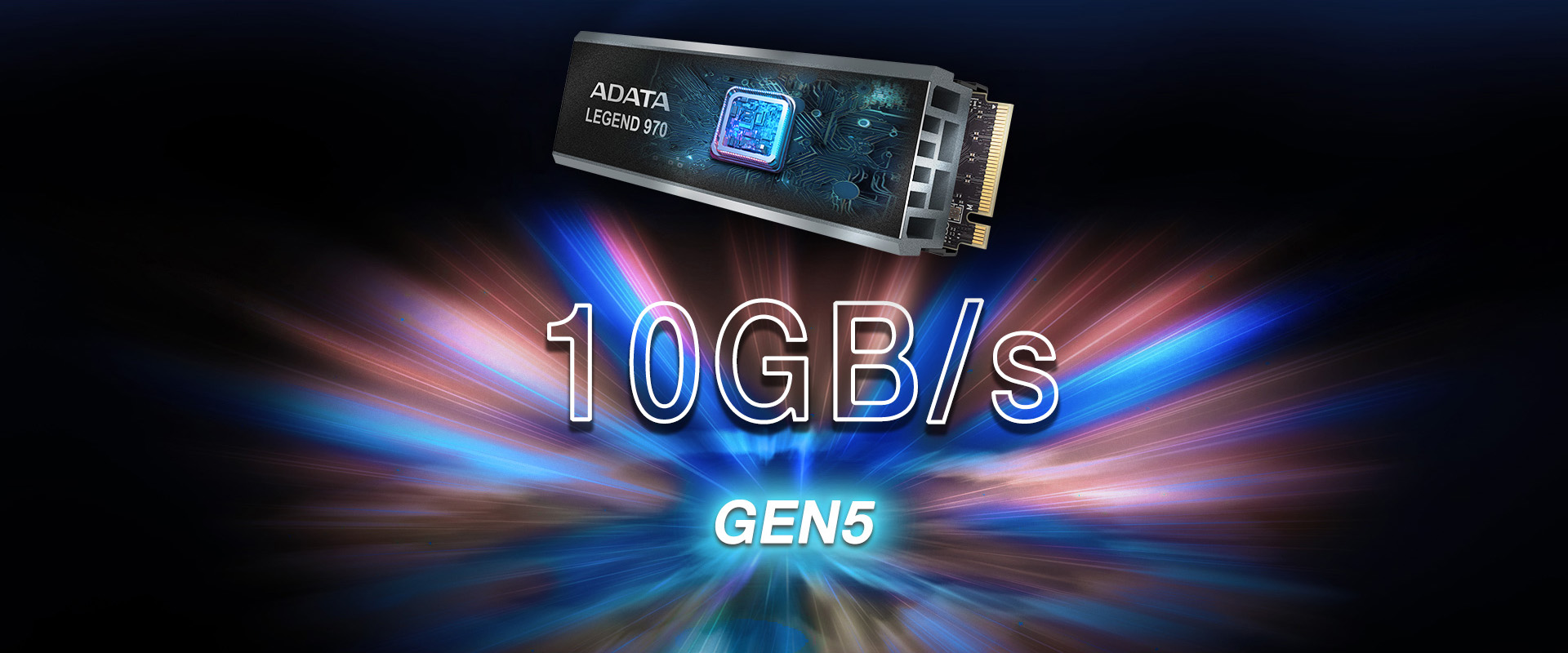
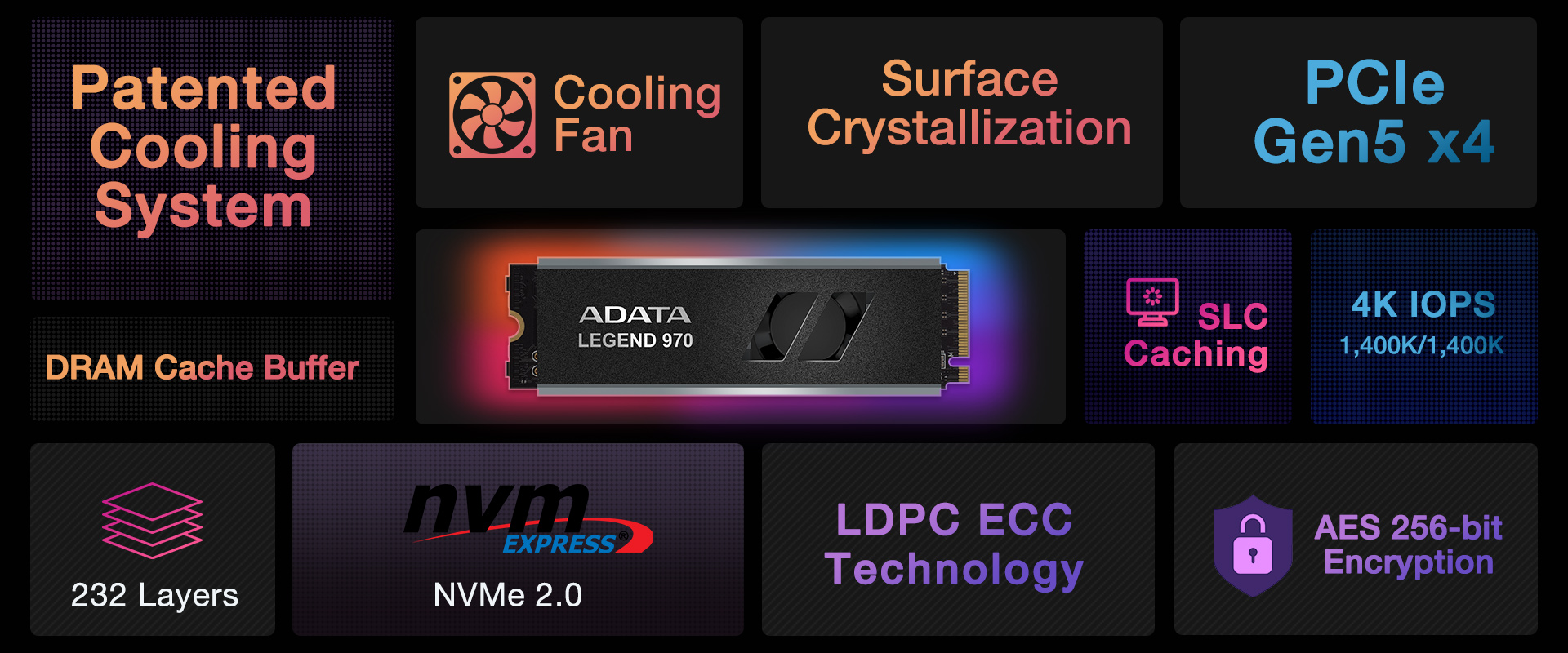
The LEGEND 970 adopts the latest generation PCIe Gen5 x4 transmission interface and complies with the NVMe 2.0 standard to deliver amazing read and write capabilities. The LEGEND 970 also supports the latest Intel and AMD platforms. Whether in dynamic or static output, it always provides full performance.
Unreal Performance
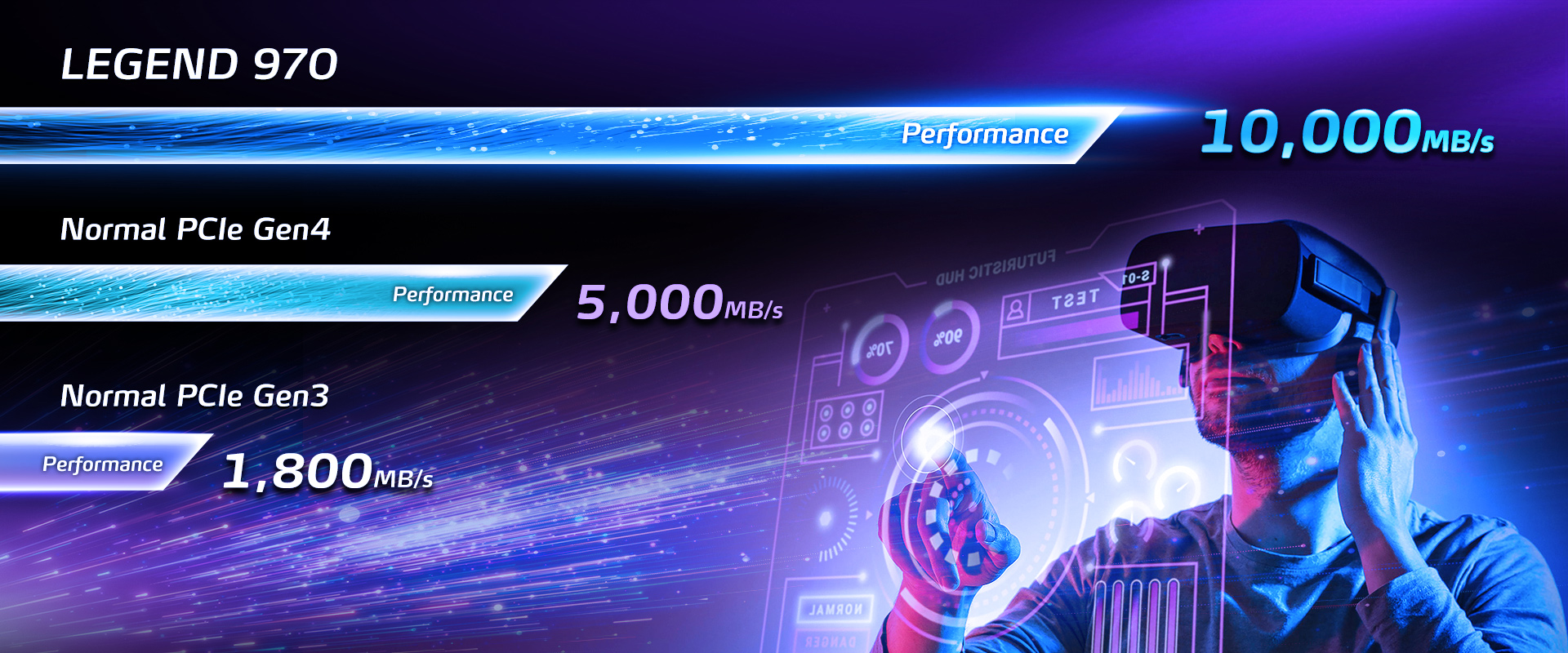
Complete every task in moments. The LEGEND 970 has a sequential read/write speed of 10,000/10,000MB per second, double the speed of PCIe Gen4 SSDs and 6 times faster than Gen3 SSDs, and is fully backward compatible with PCIe 4.0 and 3.0 platforms.
Experts of Patented Heat Dissipation
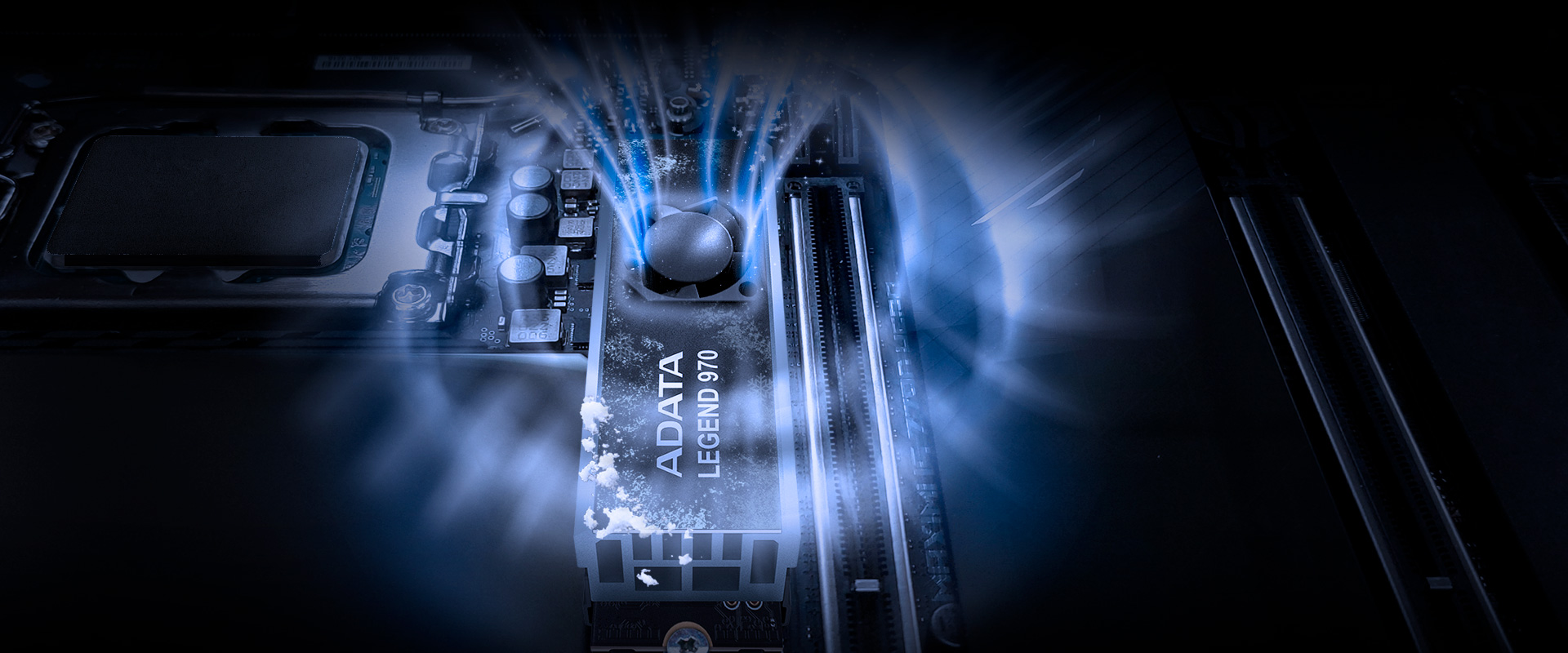
When high efficiency is required, leave it to the professionals! The LEGEND 970 adopts dual-layer extruded aluminum fins¹ to create a dense air duct to divert hot and cold air. When heat is conducted upward, a built-in micro fan is used to remove thermal energy. This unique "active heat dissipation" design delivers significantly cooler temperatures than a fanless heatsink by 10%².
1The heatsink of this product is pre-installed. Please consider installation space before adopting this product and confirm whether your motherboard is supplied with an M.2 heatsink (refer to manufacturer board manual). If so, please remove it first and then install this product with its supplied heatsink.
2This product comes with a fan attached to the SATA cable, which requires an additional power supply connection to activate the active cooling effect.
3Heat dissipation data is based on test conditions of an internal laboratory and actual figures may vary due to personal hardware, software, and test environments.
Surface Crystallization Improve Heat Dissipation
The LEGEND 970's aluminum alloy fins are treated with surface crystallization, which utilizes its physical properties to increase the overall air contact area and maximize the effectiveness of its air cooling system.

QuiKTIPS : Never Experience Throttling Again
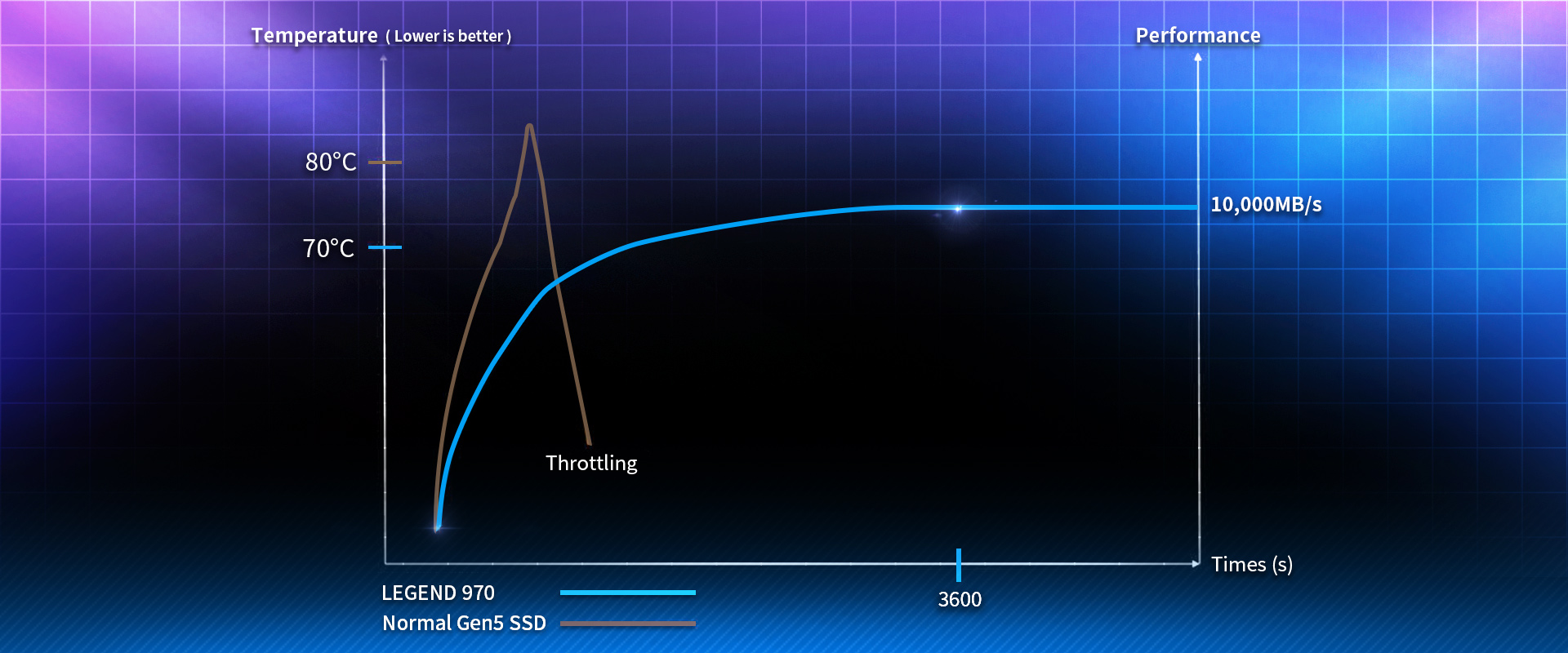
High-speed PCIe 5.0 transmission requires powerful heat dissipation. If heat is not dissipated quickly, data read/writes speeds will be adversely affected and the drive itself crashing is a possibility. The LEGEND 970's active heat dissipation mechanism withstands high temperature test and can maintain stable performance even during long bouts of high speed operation.
*Heat dissipation data is based on test conditions of an internal laboratory and actual figures may vary due to personal hardware, software, and test environments.
QuiKTIPS : Active Cooling Analysis
How does active cooling work? Active cooling works by using a tightly adhered heat dissipation pad and a metal heat dissipator to transfer heat from the SSD. The double-layered aluminum fins help facilitate the heat transfer process. Additionally, a built-in fan draws cold air from openings on the nameplate and directs it towards the aluminum fins. The hot and cold air meet, and the rotation of the fan quickly expels the heat from both sides of the aluminum fins. This design provides superior heat dissipation compared to fanless heatsinks.

High Quality Memory Components
Strict selection of 232-layer 3D flash memory gives the LEGEND 970 a capacity of up to 2000GB and it utilizes a variety of data protection and correction technologies to increase total bytes written (TBW) and durability to meet various high-load requirements.

Superior Technology
LEGEND 970 leverages the advantages of a SLC cache algorithm and DRAM Cache Buffer while featuring 4K random read/write IOPS up to 1,400K/1,400K, further improving the efficiency of multi-file processing. The LEGEND 970 also adopts a LDPC (Low Density Parity Check Code) error correction mechanism and AES 256-bit high-level encryption technology to ensure the accuracy of data transmission and the security of files.
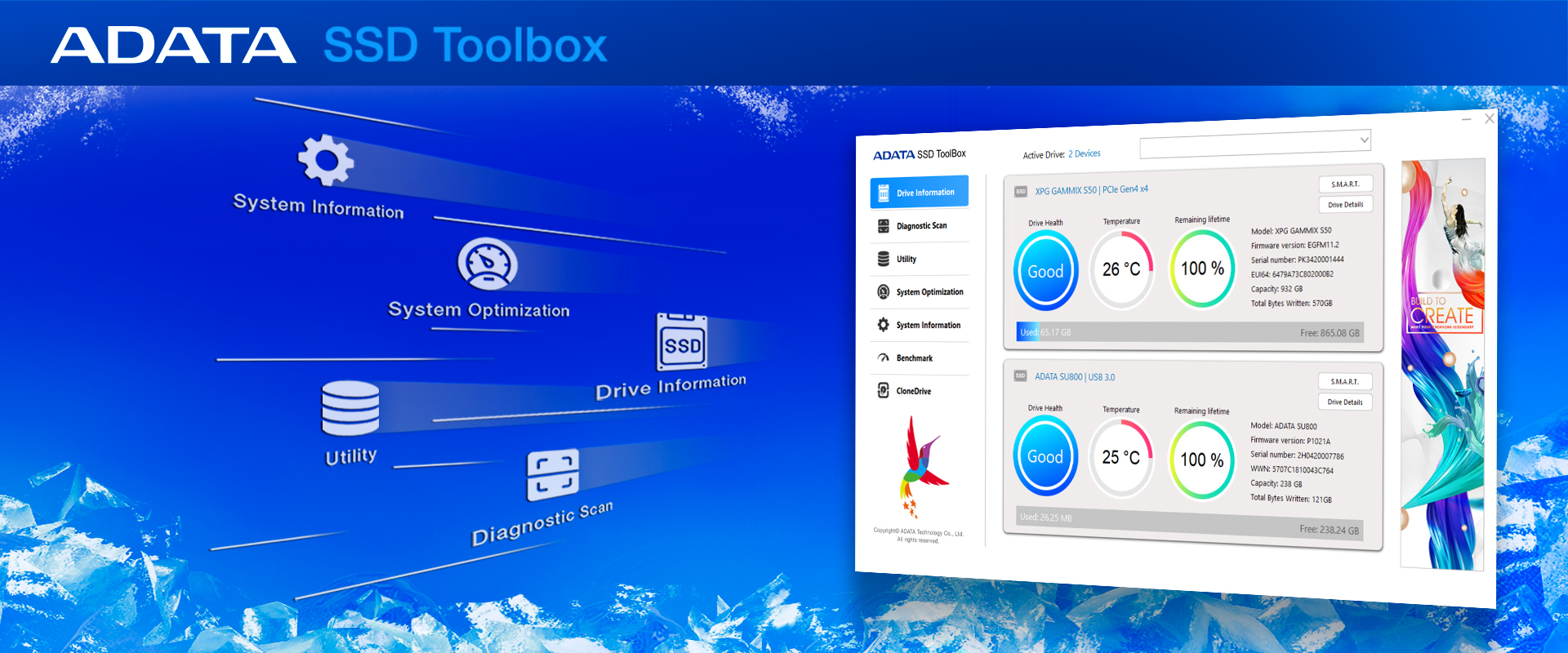
SSD Toolbox value-added software for real-time status monitoring
SSD Toolbox ensures users utilize the latest Firmware version for the best performance and employs Self-Monitoring, Analysis and Reporting Technology (S.M.A.R.T.) to understand the health and remaining lifespan of SSDs, as well as the current operating temperature and storage capacity, so that users can track of SSD status at any time.
Preview a new era of patented heat dissipation! The LEGEND 970 Gen5 SSD adopts dual-layer aluminum alloy heat dissipation fins and a micro fan to create a comprehensive cooling structure while heatsink surface crystallization treatment improves the heat dissipation mechanism, enabling stable long-term operation.
| Remark | Important reminder: If the SSD itself has heat sinks, disassembling and removing the heat sink yourself is considered man-made damage and will not be covered by the warranty. * This product is compatible with the latest Intel and AMD platforms and must be used with a motherboard that supports PCIe 5.0 to achieve optimal performance. Actual performance may vary depending on the hardware and software configurations. * This product is backward compatible with PCIe 4.0 and 3.0. * Test system configuration : M/B : ASUS Z790 STRIX E-Gaming WIFI , CPU: i7-13700K, RAM: 16GBx2 DDR5-5200 ** The value is the minimum amount of terabyte written that could be reached. *** The SSD is based on the TBW or Warranty period. Visit https://www.adata.com/us/support/warranty/ for more details. |
|---|
- A:
Please first confirm whether you have set the SSD as a virtual disk (Control Panel>System and Security>Storage Spaces). Toolbox is unable to detect a virtual disk. You can delete the virtual disk in Storage Spaces or format and initialize the SSD in Disk Management. Toolbox will then recognize the SSD.
- A:
ADATA SSD warranties are based on warranty period or Total Terabytes Written (TBW).
1. Please refer to this link for specific warranty information for your product.
https://www.adata.com/en/support/warranty/
2. Please refer to this link for the TBW of your product.
- A:
DRAM buffer is a function designed to improve the efficiency of reading and writing. Generally, it is composed of 1 to 2 DRAM modules on an SSD. Whether an SSD has a DRAM buffer is often decided by the manufacturer according to its market positioning. Generally speaking, entry-level models do not typically have a DRAM buffer.
- A:
Wear leveling is a process that is designed to extend the life of solid state storage devices. SSDs are store data in blocks. Each block can tolerate a finite number of program/erase cycles before becoming unreliable. For example, MLC NAND flash is typically rated at about 3,000 program/erase cycles. Wear leveling arranges data so that write/erase cycles are distributed evenly among all of the blocks in the device.
- A:
SSD TRIM is an Advanced Technology Attachment (ATA) command that enables an operating system to inform a NAND flash solid-state drive (SSD) which data blocks it can erase because they are no longer in use. The use of TRIM can improve the performance of writing data to SSDs and contribute to longer SSD life. Currently, TRIM is used in Windows 7, Server 2008, Mac OS 10.7, and newer versions of Linux. In addition, regardless of operating system, no RAID configuration supports TRIM.
- A:
According to the Serial ATA International Organization the SATA 3.0 specification offers transfer speeds up to 6Gbps compared to 3Gbps for SATA 2.0. Regardless, SATA 2.0 and SATA 3.0 use the same interface and cables.
- A:
At present, various storage methods, including optical discs, hard drives, and SSDs are not ideal for storing data permanently. Therefore, we recommend that important data be backed up to several different devices to diversify your risks.
- A:
The lifespan of an SSD is based on its health. ADATA's SSD ToolBox is a set of auxiliary software for checking SSD health. In principle, your health will be determined by the length of time you use your SSD and the number of read and write cycles. The longer you use it, the more read and write cycles, the shorter the lifespan of your SSD. Generally speaking, SSDs have wear-leveling technology built-in that helps extend the lifespan of your SSD. However how you use your SSD is the main factors in determining your SSDs lifespan. If a large amount of data is written over a long period of time or if you use your SSD in extreme environments, lifespan may be shortened.
Download ADATA SSD ToolBox: https://www.adata.com/us/support/downloads/
- A:
Speeds may vary because different test software use different parameter settings and test methods, and the different testing environments and PC configurations may also have an influence (for example: different motherboards or CPUs, etc.). In addition, the amount of free space, namely lack of, will also affect writing speeds. For better performance, you can try the following:
1. Please check if the slot currently used by the SSD can support the specifications of the SSD. (For example, if a PCIe Gen3x4 SSD is inserted into a PCIe Gen3x2 slot, the speed will be limited by the PCIe Gen3x2 slot)
2. Remove unnecessary software or data from the SSD, or reformat it.
3. Use CrystalDiskMark or ATTO Disk Benchmark to test your SSDs speeds.
4. If your SSDs speed is still slow, please take a screenshot of your SSDs speed test results and send it to our customer service staff for review.
- A:
The difference in capacity is mainly due to the different calculation methods used by your PCs operating system and the SSD. SSDs calculate capacity based on the decimal system, e.g.: 1KB - 1000 Byte bytes, 1MB - 1000KB, 1GB - 1000MB, 1TB - 1000GB, and so on; Your PCs operating system uses the binary system, e.g. 1KB x 1024 Byte byte, 1MB x 1024KB, 1GB x 1024MB, 1TB x 1024GB, and so on. For example, if the packaging shows capacity or 500GB, it is calculated as follows: 500GB x 500 x 1,000MB x 1,000KB x 1,000Byte x 500,000,000,000Byte. Your PCs operating system will calculate as follows: 500,000,000,000 Byte/1024KB/1024MB/1024GB, or approximately 465GB.
Remarks: For a faster calculation method, the capacity listed on the packaging can be calculated as x0.93=SSD for approximate capacity
- A:
HDD Sentinel Health displays anomalies because this tool incorporates the S.M.A.R.T attribute 168 (A8), 159 (9F) fields into the health display, but these two fields are self-defined by each vendor, so these two fields are not associated with health calculations. Please remove the wrong interpretation position of the two fields according to the illustration, and the SSD health can be displayed as normal.
- A:
This is related to the storage format of your SSD. If using the Windows FAT32 format, the maximum size of any single file is limited to 4GB. To avoid this situation, please change reformat your SSD to NTFS.
- A:
Troubleshoot with the following:
1. The SSD has wear-leveling technology built-in to enhance the product's lifespan. The slower speeds may be due to concurrent reformatting, but this situation is not common, especially when it is not a brand new SSD. Contact our customer service staff for help in troubleshooting.
2. Insufficient free space will also affect the writing speed. You can try to delete files to free up space on your SSD.
- A:
ADATA SSDs are designed in accordance with the Serial ATA International Organization standards and have undergone rigorous testing to ensure they work with various operating systems.
Note:
1. NVMe (PCIe) M.2 SSDs require Windows 8.1 or later to support the NVMe driver (we recommend Windows 10 for better the best experience and usability). Linux, including Fedora, SUSE, Ubuntu, and Red Hat, is also supported.
2. AHCI(SATA) M.2 SSDs can be used with Windows 7 or later.
- A:
Since SSDs don't have mechanical drives, so there is no need for defragmentation. Defragmenting an SSD may cause unnecessary wear and tear. SSDs are designed to write data evenly on the entire drive as much as possible, thereby reducing excessive wear on any one location.
- A:
ADATA SSDs can use standard drivers, which can be applied to different operating systems; at the same time, users can also install the drivers officially provided by the motherboard manufacturers. If you have other questions, please contact ADATA's customer service center.
Note:
1. NVMe (PCIe) M.2 SSDs require Windows 8.1 or later to support the NVMe driver (it is recommended to update to Windows 10 or later). Linux series such as Fedora, SUSE, Ubuntu, Red Hat are also supported
2. AHCI (SATA) M.2 SSDs are compatible with Windows 7 and later
- A:
Set up RAID 0 on a compatible motherboard, then connect two SSDs of the same specification to the set port. For detailed instructions, please refer to your motherboard's user manual. The performance of the SSD with a RAID 0 configuration will be double that of a single SSD.
- A:
If you have used the SSD normally before, but then fails to format, please try the following steps:
1. Enter "diskpart" in the command line of the "Start" menu and press "Enter" (or use the "Windows" key and "R")
2. Enter "List disk" and press "Enter" to check the hard disk number (the system disk is Disk 0. If only 1 SSD is connected, it should labeled as Disk 1.)
3. Type "select disk 1" and press "Enter" to select the SSD
4. Type "clean" and press "Enter", the partitions of the SSD will be deleted
- A:
1. Make sure you have already formatted and partitioned your new 2.5" SATA of M.2 SSD. For detailed instructions for Windows 7, please click here; For Windows 8.1 or Windows 10, please click here; For Windows XP, please click here.
2. If your SSD cannot be detected (including unrecognizable, unreadable, etc.) after it has worked normally for a period of time, please follow steps:
M.2 SSD => Loosen the screws and remove the M.2 SSD and check the interface connector for dirt or scratches. Then reinstall it.
SATA 2.5-inch SSD => Unplugged the SATA cable and check the interface connector for dirt or scratches. Then reinstall and ensure the cable is properly plugged in. In some cases, an old cable may cause your SSD to not be detected.
If you have tried the above but the problem persists, the SSD might be faulty. Check your warranty period on ADATA's official website.
Query URL: https://www.adata.com/en/support/warranty/
If it is inconvenient for you to visit a service center for repair, you can apply for online repair at ADATA's website:
https://www.adata.com/us/member/login/
After completing the application, please follow the instructions to properly package the product and then send it to the designated address. After ADATA has received your product, we will begin to process it as soon as possible.
[Important reminder:]
1. ADATA service centers are only responsible for repairing products with malfunctions not caused by the user (the product must have no exterior damage and the stickers must remain intact) The warranty scope and authenticity of the product will be determined by the original factory based on the product received for repair.
2. It is recommended to take photos of the front and back of the product for your later reference before sending it in for repair.
3. ADATA only repairs the product and does not provide data backup services. Please be sure to back up your data. If the data is lost or damaged due to the repair process, the ADATA will not be held responsible.
- A:
If you encounter this problem, please refer to your motherboard's user manual or the manufacturer's website. Motherboards vary by model and brand. The type and quantity of I/O ports are not the same; therefore, when a SATA or NVMe M.2 SSD is inserted into the slot, it may be affected by I/O. The sharing of channels by the ports results in a limited number of channels supported by the chipset, rendering some 7pin SATA sockets unusable.
- A:
PCs that do not support PCIe Gen4 SSDs can still use the said SSDs. However, the SSDs performance will be limited to PCIe Gen3 levels.
- A:
Firstly check the make and specifications of your motherboard on the manufacturers website to see if it has M.2 slots that support PCIe 4x4. If there are two M.2 PCIe 4x4 slots, you can use the direct link to the CPU terminal (center Processor) M.2 socket for better performance
- A:
Firstly, confirmed your SSDs form factor - M.2, mSATA, or SATA. Locate the correct slot type on your motherboard, insert your SSD and secure it with screws. For video instructions, M.2 SSD on desktop please click here, M.2 SSD on laptop please click here, SATA SSD on desktop please click here, SATA SSD on laptop please click here.
- A:
If you have an M.2. 2280 SSD, you can find installation instructions here.